How We Manage a Multi-Location Corporate Video Production in Malaysia
Quick Answer: Managing a multi-location corporate video production requires a centralised pre-production plan that locks down locations, shoot sequences, travel logistics, and visual consistency standards before any crew departs. The biggest risk is not distance — it is inconsistency. Footage shot across three cities needs to cut together seamlessly, which means lighting, colour, framing, and audio treatment must be standardised from site one to site five.
For companies operating across multiple offices, plants, or regions, a single-location shoot simply does not tell the full story. A manufacturing group with facilities in Kuala Lumpur, Penang, and Sarawak. An insurance company with regional branches nationwide. A renewable energy developer with solar farms spread across three states. These organisations need corporate video that reflects their actual scale — and that means the production team has to show up in all of those places and come back with footage that feels like a single, coherent film. 8THREE has produced multi-location corporate videos for clients who owned facilities in multiple locations. This guide walks through exactly how we plan and execute shoots like these.
What Makes Multi-Location Corporate Video Different From a Standard Shoot?
A single-location video shoot is a contained logistical problem. We move the crew in, we shoot, we move the crew out. A multi-location production multiplies every element of that problem — and adds new ones.
The core differences:
- Logistics compound quickly. Three locations means three travel plans, three accommodation arrangements (where overnight stays are needed), three site access requests, and three sets of local contacts to coordinate. Miss one and you lose a shoot day.
- Visual consistency becomes an active challenge. Location 1 might be a glass-and-steel corporate lobby in KL. Location 2 is a factory floor in Penang with fluorescent strip lighting. Location 3 is an outdoor solar farm under harsh Malaysian midday sun. Without a clear visual approach defined upfront, these three environments will produce footage that looks like it came from three different videos.
- Stakeholder management multiplies. Each location typically has its own internal point of contact, its own schedule constraints, and its own idea of what the video should show. Aligning all of them without the client having to manage it is a significant coordination task.
- The edit is where multi-location shoots succeed or fail. If the footage from each site does not match in colour temperature, audio quality, and visual framing, no amount of post-production skill will make the film feel cohesive. Consistency has to be built in during production — not fixed afterwards.
How Do We Plan a Multi-Location Corporate Video Shoot?
Planning a multi-location production is a different discipline from planning a single-site shoot. It requires more pre-production time, more structured communication, and earlier decisions that cannot be reversed once the crew is on the road.
Here is 8THREE’s standard planning sequence for multi-location projects:
1. Master location audit Before scripting, list every location being considered. For each one, document: the visual environment (indoor/outdoor, lighting conditions, size), any access restrictions (safety inductions, operating hours, permit requirements), and the key contact who controls access. This audit is done before a single shot list is written.
2. Shoot sequence optimisation Order the locations to minimise transit time and maximise crew productivity. Flying to Kota Kinabalu on Day 1 and then shooting Penang on Day 3 with a KL night in between wastes budget and energy. A well-sequenced shoot plan builds a logical geographic route — even if it does not follow the narrative order of the final film.
3. Standardised shot list per location Each location needs its own shot list, but the shot categories should be consistent across all sites. If Location 1 captures a CEO interview, a team-at-work sequence, and an exterior establishing shot, the same three content pillars should be planned for every other location. This gives the editor consistent building blocks to work with.
4. Technical briefing document Before travelling, the 8THREE director prepares a technical spec sheet that locks in: camera settings (frame rate, colour profile, ISO ceiling), lighting approach for each environment type, audio setup, and any approved deviations. Every crew member — whether it is a 2-person or 5-person team — works from this document. Consistency comes from documentation, not from hoping everyone shoots the same way by instinct.
5. Client communication map For each location, identify one internal client contact who has authority over access, talent availability, and schedule. During a multi-location shoot, the production team cannot be escalating decisions up an internal chain while the crew stands waiting. The communication map makes this clear before travel begins.
How Does 8THREE Coordinate Multi-Location Shoots Across Malaysia?
8THREE operates on what we call a Concierge Production model — the client hands over the brief and the production team manages everything from that point forward. In a multi-location context, this means the client does not need to act as a coordinator across their own internal teams. 8THREE takes that role.
In practice, this looks like:
- Pre-shoot calls with each location contact — separate from the main client meeting — to confirm access, scheduling, and any site-specific requirements. For industrial sites like OM Holdings in Sarawak, this includes the safety officer, not just the marketing contact.
- A single master production schedule shared with all stakeholders, broken down by location and day. No one is surprised by when the crew is arriving.
- One point of contact on the client side who receives consolidated status updates, not a separate stream of communication from each location.
- Equipment packed for every environment in advance. A multi-location kit that covers a corporate office, a factory floor, and an outdoor industrial yard does not look like a standard office shoot kit. Extra lighting, protection for equipment in humid or dusty environments, and backup audio options are all packed before departure — not sourced on location.
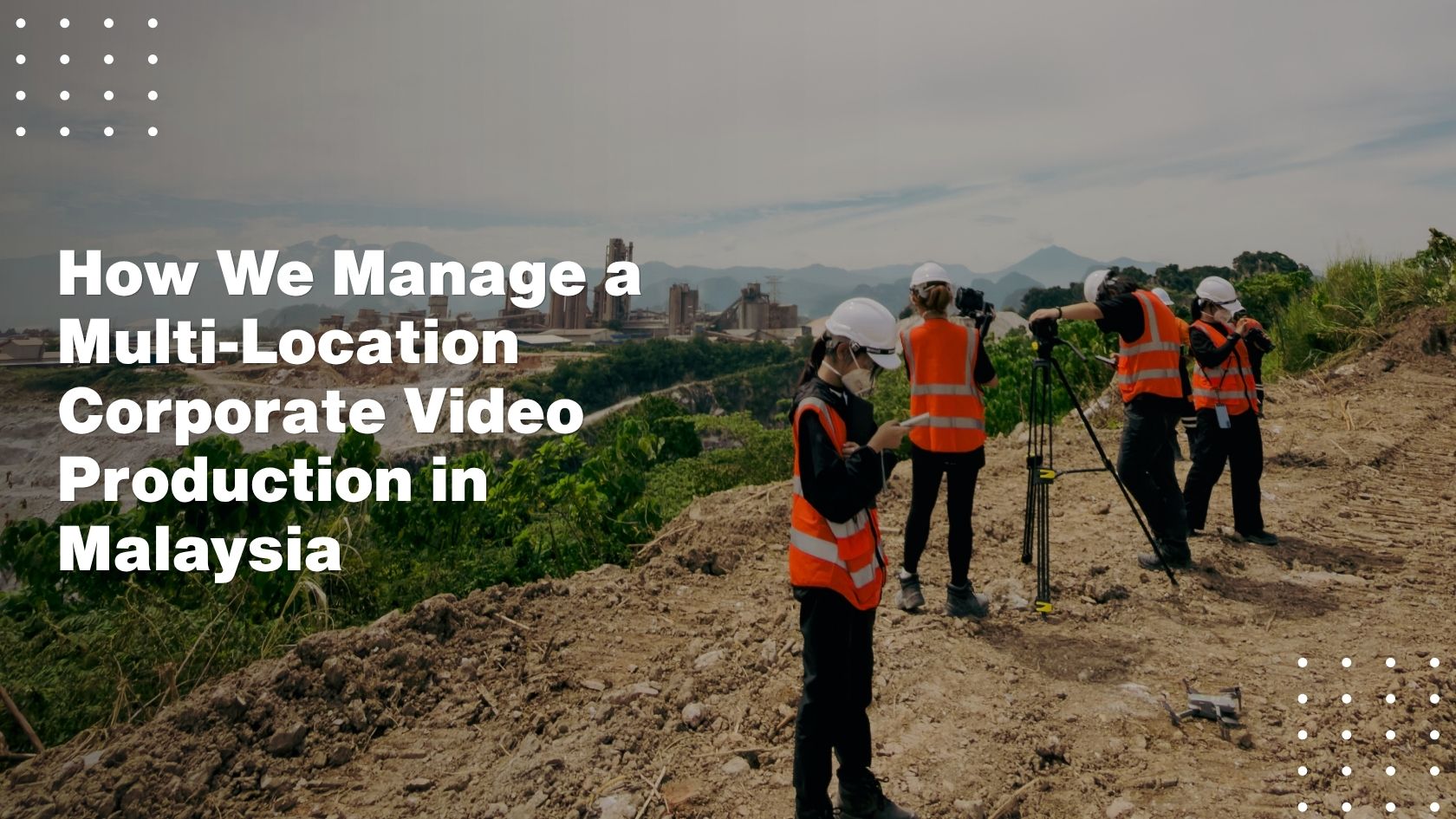
For the OM Holdings project in Sarawak, for example, 8THREE managed travel to a remote smelting facility, coordinated with the site’s HSE team on safety protocols, and executed a full corporate video and photography shoot across multiple plant areas — with zero logistical surprises for the client’s team.
How Do We Keep a Multi-Location Corporate Video Visually Consistent?
Visual consistency is the technical challenge that separates a professional multi-location video from a patchwork of footage that happens to feature the same logo. Here is how it is maintained:
Colour temperature standardisation Every environment has a different dominant light source — daylight, fluorescent, tungsten, LED. The camera’s white balance must be set correctly at each location, and additional lights are used to supplement or correct the ambient source. Without this, interviewees filmed in different locations will have different skin tones in the final edit.
Consistent framing ratios Interview setups should follow the same framing convention across all sites — same eye-line position, same approximate lens focal length, same depth-of-field style. Cutting between a tight 85mm interview in KL and a wide 35mm interview in Penang feels disjointed, even if the viewer cannot articulate why.
Matched audio treatment Large industrial halls, glass office atriums, and outdoor environments all have dramatically different acoustic profiles. Lavalier microphones help, but the audio capture approach and post-production EQ treatment must be consistent. A location that sounds echoey while others sound dry will stand out immediately.
A unified colour grade In post-production, all footage from all locations is graded in the same session by the same colourist working from a single reference frame. This is standard practice at 8THREE — every project is graded as a whole, not location by location.
What Does a Realistic Timeline Look Like for a Multi-Location Shoot?
| Phase | Duration | Notes |
|---|---|---|
| Brief and scope finalisation | 3–5 days | All locations confirmed, key contacts identified |
| Pre-production | 2–3 weeks | Shot lists, travel planning, site access coordination, technical brief |
| Production (shoot days) | 3–7 days | Varies by number of locations and travel distances |
| Post-production | 2–3 weeks | Longer than single-location due to volume of footage and consistency grading |
| Review and revisions | 1 week | 2 rounds standard |
| Total | 6–10 weeks | From confirmed brief to final delivery |
East Malaysia locations (Sabah, Sarawak) add transit days and require accommodation planning. Projects in remote industrial areas — logging, energy, or mining operations — may require additional safety approvals that extend the pre-production timeline.
Frequently Asked Questions
Q: Does a multi-location shoot cost significantly more than a single-location video? A: Yes, but the relationship is not linear. Travel, accommodation, and additional shoot days are the main cost additions. A 3-location shoot across Peninsula Malaysia might cost 40–60% more than a single-location equivalent. A production that requires flights to Sabah and Sarawak will carry higher logistics costs. 8THREE provides location-by-location cost breakdowns in every multi-location quote so the client can see exactly where the budget is going.
Q: Can 8THREE handle shoots in East Malaysia (Sabah and Sarawak)? A: Yes. 8THREE operates nationwide and has executed productions in Sarawak at OM Holdings’ smelting facility and across locations in Peninsular Malaysia for clients including Milieu Solar. East Malaysia logistics — flights, accommodation, equipment transport — are managed as part of the production plan, with costs itemised transparently.
Q: What if different locations have very different visual environments — office vs factory vs outdoor? A: This is the most common multi-location challenge, and it is solved in pre-production, not post-production. 8THREE’s technical briefing document establishes a visual approach that works across all environments — lighting strategy, framing style, colour profile — before the crew travels. The goal is footage that cuts together naturally, regardless of the environment it was captured in.
Q: How long can a multi-location corporate video realistically be? A: A 3–5 minute finished video is the most common format for multi-location brand films. This gives enough time to represent multiple sites meaningfully without losing viewer attention. Alongside the main film, 8THREE typically plans shorter 60–90-second edits from the same footage for social media use — maximising the value of the multi-location shoot budget.
Q: Do we need to be present at every location during the shoot? A: Not necessarily. 8THREE’s Concierge Production model is designed for clients who cannot — or do not want to — travel to every shoot location. The crew works from the agreed brief and shot list, with daily progress updates. Client review happens on the rough cut, not during the shoot itself. Many clients with multi-location projects find this approach significantly less demanding on their internal teams.